The short answer
Our manufacturer checks its liposomes in two ways: particle-size analysis in its own lab, and electron microscopy carried out with the Institute of Plant Sciences and Microbiology at the University of Hamburg. In its November 2023 tests, most of the particles in its vitamin C and magnesium formulas measured between 80 and 250 nanometres. Microscope images of its vitamin C liposomes show the double wall that makes a liposome a liposome.
What is a liposome?
A liposome is a tiny bubble whose wall is made of two layers of phospholipids, the same type of fat that cell membranes are built from. In our formulas the phospholipids come from sunflower. Water-soluble nutrients such as vitamin C are carried in the water inside the bubble, and fat-soluble ones such as vitamin D sit within the wall. At 80 to 250 nanometres across, these liposomes are several hundred times narrower than a human hair.
Making liposomes at scale isn’t simple. Phospholipids and water have to be given enough mechanical energy to fold into closed, double-walled spheres that stay stable over time. Scientific reviews describe a range of methods for doing this, each with its own trade-offs [1, 2].
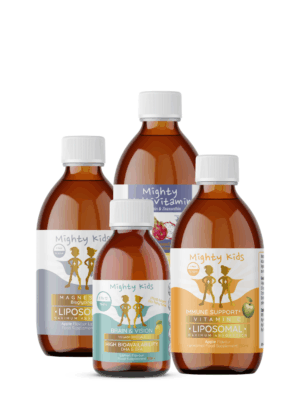
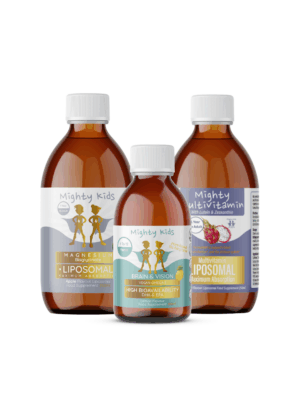
Our liposomal products are:
- Magnesium
- Vitamin C
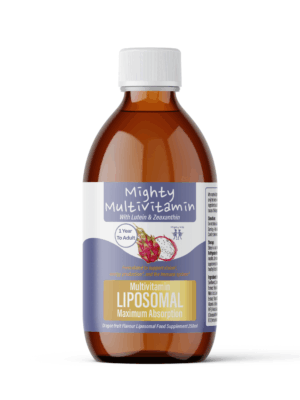
- Multivitamin
- Vitamin D3 & K2
Our Vegan Omega-3 is a pure algae oil, not a liposomal product.
Why checking matters
A “liposomal” label doesn’t guarantee there are liposomes in the bottle. When the UK’s Committee on Toxicity reviewed the liposomal supplement market, it noted reports that some products sold as liposomal contain none. It also recorded a ruling by the Advertising Standards Authority against a brand that couldn’t show its product contained liposomes (Committee on Toxicity). We think parents should be able to see how ours are checked.
The two checks at a glance
| Check | Carried out by | Formulas tested | When | Result |
|---|---|---|---|---|
| Particle-size analysis | Our manufacturer, in its own lab | Vitamin C, magnesium | November 2023 | Most particles 60–300 nm; median between 80 and 250 nm |
| Electron microscopy | Institute of Plant Sciences and Microbiology, University of Hamburg, with our manufacturer | Vitamin C | January 2022 and November 2023 | Round vesicles with a double phospholipid wall, roughly 80–250 nm across |
Check 1: particle-size analysis
A laser is shone through a liquid sample. Particles scatter the light at different angles depending on their size, and detectors at three angles turn that pattern into a size distribution. Our manufacturer uses a Beckman Coulter LS 13 320 analyser, and passes each sample through a 0.45-micron filter first to remove larger plant particles [4, 5].
Its November 2023 tests covered vitamin C and magnesium formulas, alongside three products we don’t sell. Most of the particles measured 60 to 300 nanometres, with a median between 80 and 250 nanometres.
Check 2: electron microscopy
Liposomes are too small to photograph with an ordinary light microscope. Instead, a sample is dried onto a metal grid and viewed under a transmission electron microscope, which uses a beam of electrons in place of light. Our manufacturer had its vitamin C liposomes imaged this way in January 2022 and November 2023 at the University of Hamburg, at 60,000 times magnification.
The images show round vesicles with bright edges, which the institute identified as a double layer of phospholipids. Individual liposomes measured roughly 80 to 250 nanometres. Some in the images have collapsed, which is expected, because the sample loses its water in the microscope’s vacuum. Liposomes need water to hold their shape, and removing it, whether in a microscope or during manufacturing, can damage them. [3].
What these checks don’t tell you
- How well a nutrient is absorbed. That needs studies in people; see what the research shows.
References
- Mozafari MR. Liposomes: an overview of manufacturing techniques. Cellular & Molecular Biology Letters. 2005;10(4):711–719.
- Patil YP, Jadhav S. Novel methods for liposome preparation. Chemistry and Physics of Lipids. 2014;177:8–18.
- Franzé S, Selmin F, Samaritani E, Minghetti P, Cilurzo F. Lyophilization of liposomal formulations: still necessary, still challenging. Pharmaceutics. 2018;10(3):139.
- Stieß M. Mechanische Verfahrenstechnik – Partikeltechnologie 1. Springer; 2009:9–94.
- Beckman Coulter. LS 13 320 XR laser diffraction particle size analyser: instructions for use. 2019.
- UK Committee on Toxicity. Uncertainties surrounding novel supplement formulations.