What Does 13% NRV Really Mean for a Magnesium Supplement?
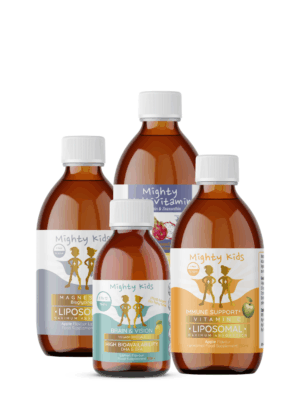
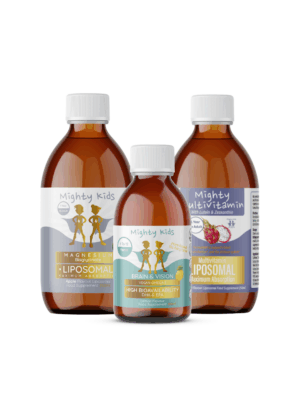
NRV stands for Nutrient Reference Value. The NRV percentage on a supplement label tells you how much of the daily reference amount for a nutrient is provided by one serving. At first glance, you might notice that our Mighty Kids Magnesium provides between 6% and 20% of the NRV depending on your child’s age, which might seem pretty low. However, magnesium supplementation isn’t quite as straightforward as you may think. The amount of magnesium your child consumes isn’t always the same amount that their body absorbs, and absorption can vary depending on where the magnesium comes from, its form, and what it is eaten alongside. Here, we’ll cover how this works and why there’s more to a magnesium supplement than the percentage on the label!
A Mighty Mineral
Magnesium might be a small part of your child’s diet, but it has plenty of jobs to do. It supports the normal functioning of the nervous system, contributes to normal muscle function and the maintenance of normal bones.
Magnesium is found naturally in foods such as spinach, nuts, seeds, and legumes. However, how much magnesium a food contains isn’t necessarily the same as how much of it the body will absorb. To understand the bigger picture, it’s worth looking at some of the different factors that can influence how much magnesium is taken up and used by the body.
What Affects Magnesium Absorption From Food?
In reality, when we consume magnesium as part of a meal, it’s eaten alongside other nutrients and compounds that can affect how much magnesium is available to the body. Certain everyday foods contain compounds that can influence this further, with some binding to magnesium and making it less available for absorption. Two of the main ones are:
- Oxalic acid: Oxalic acid, or oxalate, is a natural compound found in many plant foods. One thing that’s hardly ever talked about is the fact that spinach, which we often think of as a nutritional powerhouse, actually contains quite a lot of oxalic acid. So, although spinach is still a nutrient-rich food packed with vitamins, minerals, and other goodness, the oxalate it contains can reduce how much magnesium is absorbed.
- Phytic acid: Phytic acid, or phytate, is another naturally occurring compound found mainly in cereals and whole grains. In higher amounts, phytic acid can bind to magnesium and make it less available for absorption.
This means that some magnesium-rich foods may provide plenty of magnesium on paper, but the amount your body actually gets can vary.
On top of these factors, there’s also research looking at how the mineral content of fruits and vegetables may have changed over the years. One review, for example, cited estimates suggesting substantial declines in the magnesium content of some vegetables over the past century, although the authors noted limitations in the historical data and called for more up-to-date research.1 It proposes changes in agricultural practices as one possible explanation. While the exact scale of these changes is uncertain, it’s another reminder that the amount of magnesium in our food isn’t fixed and can vary depending on a number of factors.
The Science Behind Absorption
If the amount of magnesium on a label doesn’t tell us how much the body will actually take up, how does it work? When it comes to magnesium intake, a higher amount doesn’t necessarily mean the same proportion will make its way into the body. Studies show that this proportion tends to decrease as the amount of magnesium consumed in one go increases. Put simply, the body may take up a greater proportion of the nutrient when the amount consumed at once is lower. To understand why, it’s worth knowing that the body absorbs magnesium in two ways.
- Active transport – This happens at lower magnesium intakes. It involves specialised transport mechanisms to move magnesium across the gut wall.
- Passive diffusion – This happens as magnesium intake increases. Magnesium is moved through passive pathways where it passes between cells in the gut.
So, the proportion of magnesium absorbed tends to be highest at lower intakes, when the body can make greater use of active transport. In some studies, the proportion absorbed has ranged from around 80% at lower intakes to only 20% when magnesium intake is very high.2 While 13% NRV might initially seem like a small amount, there’s clearly more to consider than a number on a label.
Why Form Matters Too
The next part of the equation is the form of magnesium itself. In supplements, magnesium is typically bound to another compound. When browsing products, you might have noticed names such as citrate or oxide and wondered what the difference is. These compounds can influence what happens to the magnesium once it’s been ingested.
For magnesium to be absorbed, it must first dissolve and release magnesium ions, which are the form that can be taken up by the gut. Some organic forms of magnesium, such as magnesium citrate or magnesium bisglycinate, are readily soluble, meaning they dissolve and release magnesium ions easily. On the other hand, magnesium oxide, which is an inorganic form, has a lower solubility and dissolves less easily.
Magnesium bisglycinate is a readily soluble form of magnesium, with its tolerability also making it an appealing choice for children’s supplements. This is why Mighty Kids Magnesium uses magnesium bisglycinate as part of its thoughtful formulation.
How Liposomal Technology Works
You might have heard that at Mighty Kids, our supplements use liposomal delivery. What this means is that the nutrients in our supplements come wrapped in a small phospholipid (fatty) bubble. This delivery system is designed to work in two main ways.
Firstly, part of the science behind liposomes comes from the fact that the phospholipids used to make them have similarities to the lipids found naturally in cell membranes. Secondly, the surrounding lipid layer acts as a protective barrier that helps shield the encapsulated nutrient as it travels through the digestive system. These properties are part of the reason why liposomes have attracted interest. In fact, this research using our own vitamin C formulation found increased bioavailability compared with the non-liposomal vitamin C supplement tested.
The Mighty Kids Magnesium brings these different considerations together, combining magnesium bisglycinate with liposomal delivery. So, although a 13% NRV might look low at first glance, it doesn’t necessarily tell the whole story. As we’ve seen, there are several other factors worth considering, from the amount provided to the form of magnesium and how the supplement itself is formulated.
Although supplements should never replace a balanced diet, choosing a magnesium supplement isn’t just a numbers game. It’s worth looking at the formulation as a whole, and that’s exactly what we’ve done with Mighty Kids Magnesium.
Curious about what other parents are saying? We have thousands of verified reviews on our Trust Pilot page.
References:
- Workinger, J. L., Doyle, R. P., & Bortz, J. (2018). Challenges in the Diagnosis of Magnesium Status. Nutrients, 10(9), 1202. https://doi.org/10.3390/nu10091202
- Schuchardt, J. P., & Hahn, A. (2017). Intestinal Absorption and Factors Influencing Bioavailability of Magnesium-An Update. Current nutrition and food science, 13(4), 260–278. https://doi.org/10.2174/1573401313666170427162740
- Pardo, M. R., Garicano Vilar, E., San Mauro Martín, I., & Camina Martín, M. A. (2021). Bioavailability of magnesium food supplements: A systematic review. Nutrition (Burbank, Los Angeles County, Calif.), 89, 111294. https://doi.org/10.1016/j.nut.2021.111294
- Blancquaert, L., Vervaet, C., & Derave, W. (2019). Predicting and Testing Bioavailability of Magnesium Supplements. Nutrients, 11(7), 1663. https://doi.org/10.3390/nu11071663
- Shade C. W. (2016). Liposomes as Advanced Delivery Systems for Nutraceuticals. Integrative medicine (Encinitas, Calif.), 15(1), 33–36.